Exhibition – Private Collector’s Collection: Quintessence. Antoine Mortier and Zhu Tianmeng.
Born in Shanghai in 1962, Zhu Tianmeng fig. 1 settled in Belgium in 1989. The long journey that took him—at the time—by train from Beijing to Brussels confirmed his love of travel and his curiosity about Western artistic expressions. Since then, while continuing to travel to the four corners of the world and as an avid reader of Western literature and philosophy, he has sought, through his painting, to closely fuse the two cultures. Exhibiting in both the East and the West—in Brussels as well as in Beijing—he owes to China the conception of a vital breath that merges with his creative energy and ensures the work’s positive reception by shielding it from formalism.
This is essential. This breath—the pneuma of the Ancients—prevents plastic forms from becoming rigid and losing their meaning through a process of exploration and variation, ensuring that they retain a kind of immediate, sensory power, regardless of the degree of abstraction.
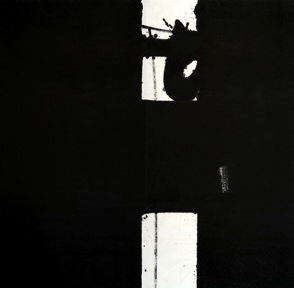
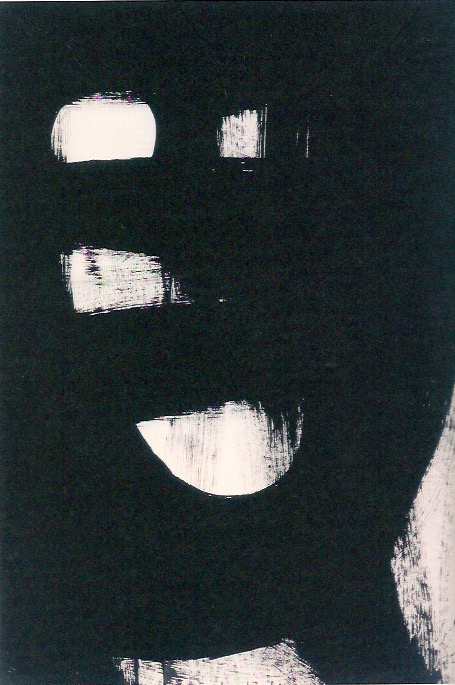
The artist, who makes his own brushes, explores the density and power of black in large spaces broken up by lines, marks, and flashes of light. The connections are unique; the void is never empty. Each ink piece is both tangible and spiritual.
Other artists long before him, in the 1950s on both sides of the divide, had discovered the richness of such an East-West convergence and inspired a whole lineage of “hybrid” works. But Zhu Tianmeng belongs to a different generation. His artistic exploration is more focused. While he takes care to preserve his background as a Chinese painter—rich with a long tradition (ink, calligraphy, line, gestural expression, and a connection to the cosmos)—he also takes care to eliminate any orientalizing references in order to arrive at the quintessence of this cultural fusion. This is evident in these powerful ink works on mounted rice paper.
In stark contrast to this legacy, Antoine Mortier (1908–1999) fig. 2 left behind numerous ink drawings on paper. Though aware of their differences, Zhu nonetheless sees Mortier as a master. This is because the Belgian painter also demonstrated total dedication. His creative output is impressive, and his approach to channeling his energy—as a former choir singer—brings the two men together. His quest to translate an initial idea into art is evident throughout his work. The two painters also share the ability to give form to visual concepts with no apparent connection to the visible or the recognizable. Certainly, in Mortier’s work, the figure and the object always come first, while in Tianmeng’s, it is the body, the landscape, and the word—which in China is an image…
But it is what comes later—the quintessence of their artistic “ideas”—that is on display today; works by both artists, of course, separated by about fifty years but selected in each case from a period of equivalent artistic maturity: the 1960s and 1970s for Mortier, who was in his sixties at the time, and the years 2020 through 2023 for Zhu Tianmeng, who is now in his sixties.