Exhibition – Cabinet d’amateur privé: A Preview of the “Encrée en matière” Exhibition at the Tsinghua University Art Museum, Beijing.
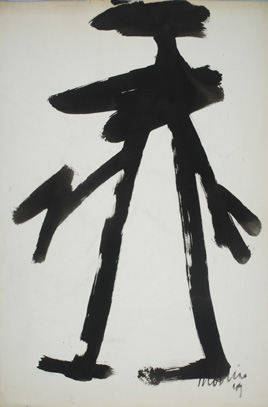
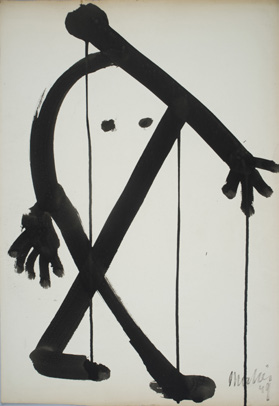
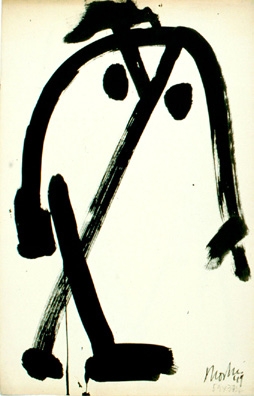
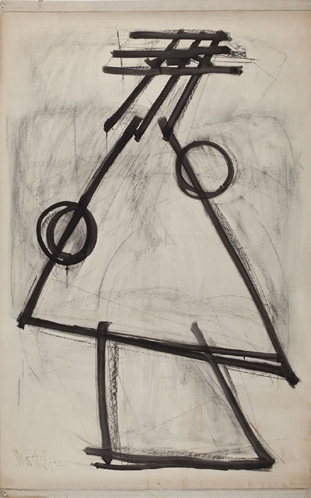
Mortier’s ink drawings fig. 1fig. 2 are numerous—ranging from small to monumental, graphic to pictorial, and from largely figurative to decidedly abstract. They are essential. Not only do they get to the heart of the matter, but they also represent, during the formative years when the artist was struggling to make ends meet, an inexpensive, fluid medium—one that relies on black and white and powerful contrasts—suited to Mortier’s expansive and abrupt vision, and adapts to any surface: cardboard, Kraft paper, translucent paper used for wrapping fish, newspaper… At times, the ink extends his gesture into a single stroke, expressing the qualities of immediacy and conciseness that are unique to him, suggesting new visual developments through the randomness of accidents and drips.
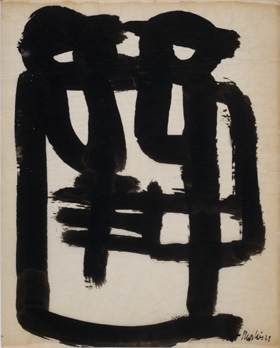
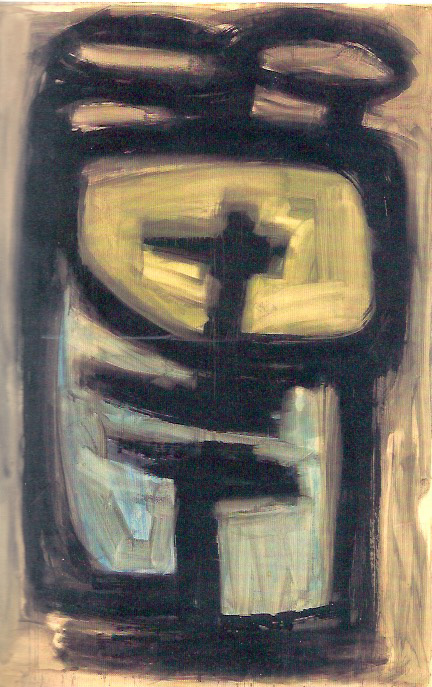
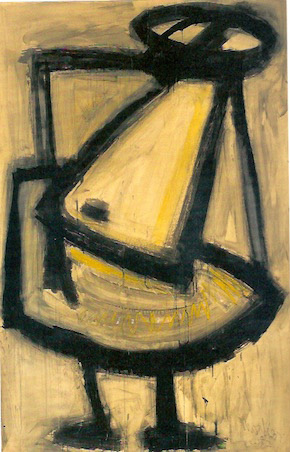
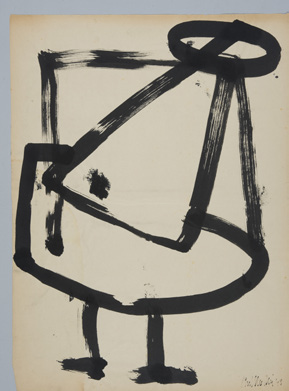
Sometimes she deconstructs the figure in two strokes, three movements, or, on the contrary, etches it into the silence of the paper—compact, unfathomable, closed off from other figures—as in Les Porteurs fig. 3fig. 4, a sort of… Russian nesting doll of drawing. Thus, the ink drawings convey emotion through a commitment to simplicity that renders them universal. Decisive in their own right, they do not “prepare” the painting. They have a life of their own and establish the painting’s language.
Omnipresent in the etchings, the man fig. 5 and the woman are characters in the usual sense of personality traits, but also in the figurative sense of symbols. La Passante fig. 6, La Paysanne fig. 7fig. 8, A l’Homme… to name just a few, demonstrate how a particular, well-defined figure, observed with humor and causticity, becomes a sign—almost an ideogram or pictogram—without losing precisely that living “character” of a human being in motion. This is due to his sense of expressive simplification, which is perhaps the essential trait of Mortier’s talent.
Therein lies the common thread, if I may say so, with Chinese art, although the latter has traditionally (except in the more everyday art of prints) focused less on the human figure and more on nature and the cosmos. The artist’s ability to anchor the figure on the page, to project it into a physical and symbolic space in order to capture its profound truth, cannot help but make the presentation of his works to the Chinese public—the custodians of a millennia-old tradition of ink painting—both enriching and thought-provoking.
Our man, however, was by no means part of the large community of Western artists who, after World War II, took such an interest in Eastern artistic values that they sometimes made them their own. As far as we know, he had no particular interest in China, which, after 1945, saw its traditional art fracture upon contact with Western art, diversify, regenerate, and, over the following decades, sometimes return to ancestral values—as, for example, the contemporary painter Zhu Tianmeng, who lives in Belgium. Political crises, the rejection of socialist realism, exile… Chinese artists traveled to the United States and Europe, such as Zao Wou-Ki, the best known, or other painters born in the 1930s, Chuang Che, Liu Kuo-Sung, Chu Wei-Bor, Hsiao Chin, and Tsai Hsia-Ling… who were passionate about ink and lyrical abstraction. They were in contact with American and European artists such as Tobey, Pollock, Hartung, Soulages, Michaux, Mathieu, Degottex…, at a time when the latter were taking a keen interest in the abstract beauty and ambivalence of calligraphy and pictograms, combining their perception of the East with abstract expressionism or the spontaneity of free writing.
That was not the case with Mortier, let’s reiterate. At that time, he was working on his own, having stormed out of La Jeune Peinture, and wanted nothing to do with national or international trends. He drew on a legacy of both ancient and modern Flemish painting and approached ink based on his own personal criteria. He quickly came to value, however, the preservation in his drawings of the momentum and sense of gesture that had reduced the figure (whether a person or an object) to a few sketchy lines in order to capture its heart—or, more philosophically, its essence.
One need only look at these two Paysannes—at once so schematic and so eloquent—to see just how much drawing and painting tend toward the archetype. There they are, these figures, just as one might come across them while walking down a familiar country path, in a friendly pose, and at the same time, they are everywhere—both concrete and abstract.
Let’s add that if, just for fun, we were to shrink these inks to the size of a Chinese character and line them up, we would notice that they visually form a script! In this quest to reach the heart of things and beings beyond their outward appearance, Mortier unwittingly echoes the use of ink by modern and contemporary—and even ancient—Chinese abstract painters. First, the Ancients—the Literati—who were sometimes rightly described as “proto-abstract.” The West does not hold a monopoly on the “discovery” of abstraction. It is important to bear in mind that calligraphy, as a creative endeavor, is rooted in philosophical values and holds unlimited potential. The calligrapher-painter need only vary the thick and thin strokes of the characters to express his emotions. They can also draw them differently to reinforce or vary their meaning, or to clarify their context. In short, the philosophical and poetic message they can convey is vast. Some even go as far as complete abstraction, so much so that one can, in fact, speak of abstraction before the term existed.
In his practice of drawing and of painting—which is broadly conceived and executed with a brush—Mortier certainly benefited from the fact that he was, for many years, an opera singer. This training, which begins with the ribcage, influences breathing, overall flexibility, and movement. This is not so far removed from calligraphy, a martial art that engages the body in a “chain reaction,” linking breathing to wrist mobility and the fluidity of movement. However distinct Mortier’s inkworks may be and however divergent the two cultural systems may be, affinities do indeed emerge on both sides, making the upcoming exhibition in Beijing an unexpected and enriching encounter.
— Danièle Gillemon, Member of the Fine Arts Class of the Royal Academy of Belgium