Exhibition – Private Collector’s Collection: L’OscArt des Amis.
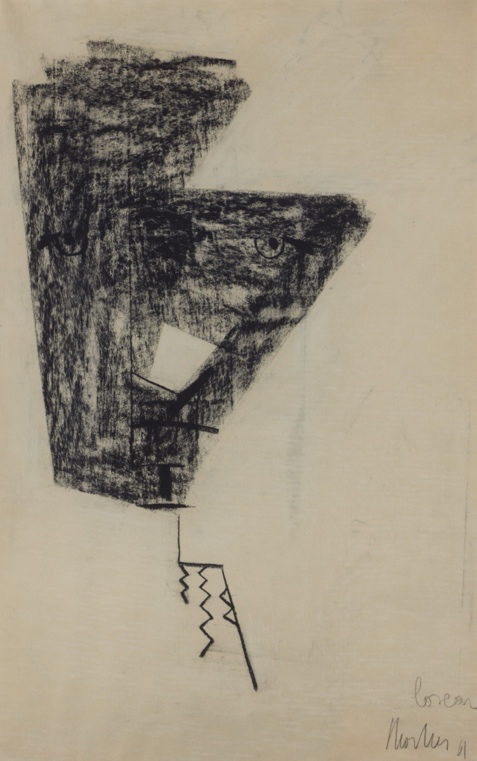
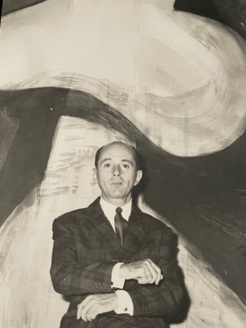
“Loscar” is the title Mortier gave to one of the portraits fig. 1 he painted of his friend Oscar Schellekens in 1961. Not just any portrait! As is often the case with his work, the blend of expressiveness and abstraction captures the very essence of an object or a face. It was in 1946 that the painter met Oscar and his wife, Cécile Houtart, at the opening of his first solo exhibition at the Apollo Gallery. Born in Ghent in 1915, an art lover from a long line of Flemish aristocracy and an engineer by training, Oscar collected works that were emerging in the immediate postwar period and seemed to him to hold the promise of a bright future. These were mainly Belgian artists, but also South American and Cuban artists, and soon the Cobra movement—an international movement with its leading figures, including Jorn, Appel, Vandercam, and Dotremont… fig. 2
His temperament and background lead him to favor art rooted in the Nordic tradition, as evidenced by his iconic interest in Teniers—who is part of his family tree—and to whom he has dedicated a book. But he is also drawn to artists who—whether more niche, like Camille De Taeye, or more international, like Marcel Broodthaers, Bram Bogart, and Henri Michaux—were championed by critics and institutions of the time.
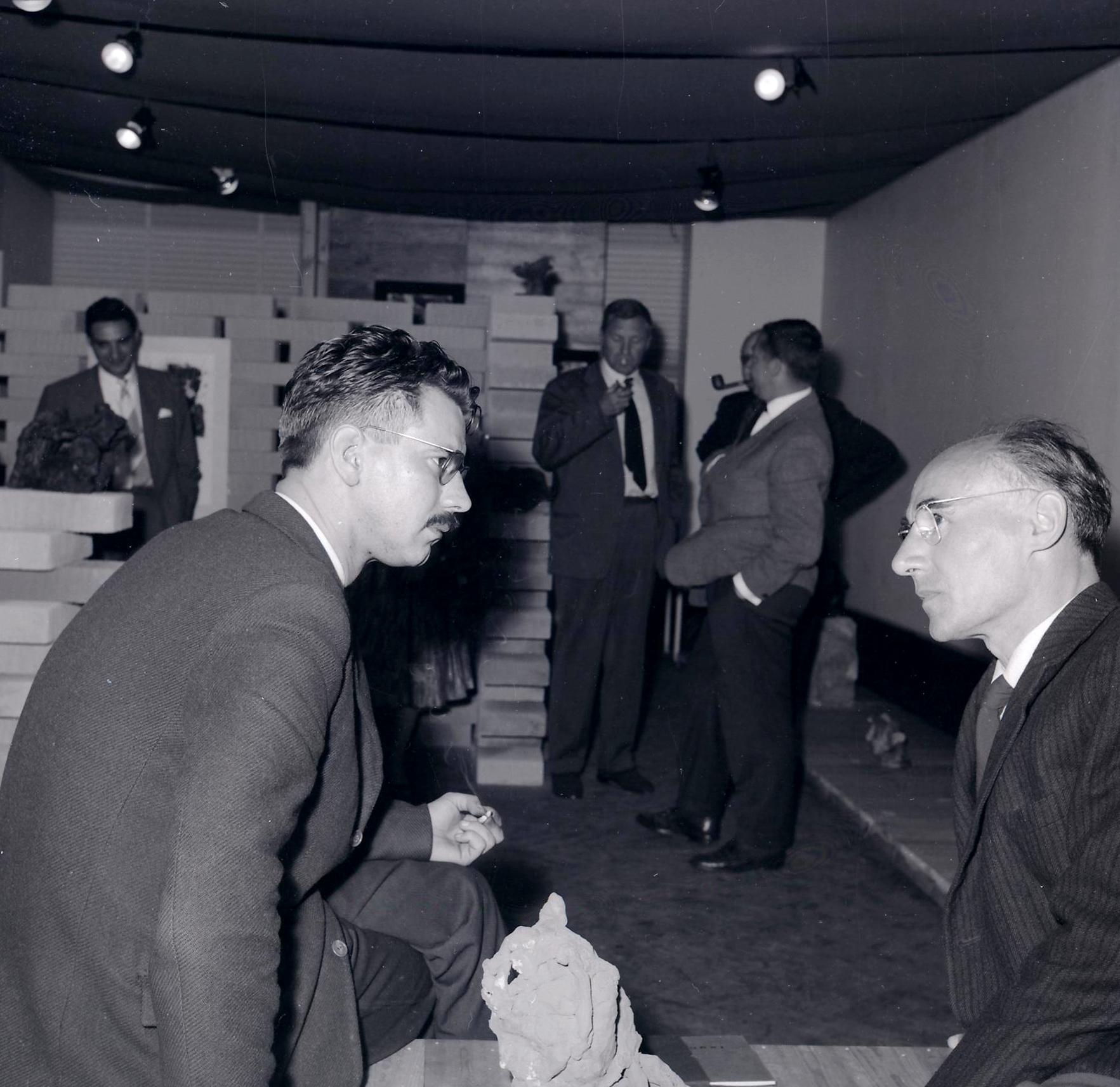
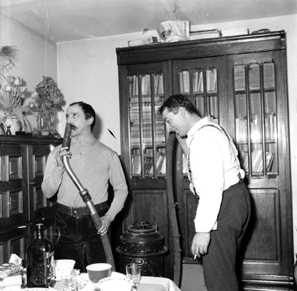
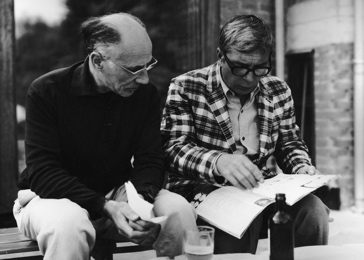
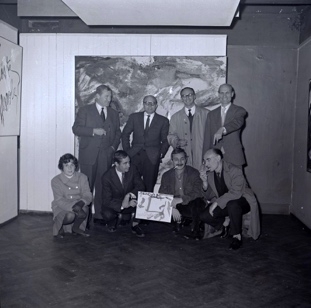
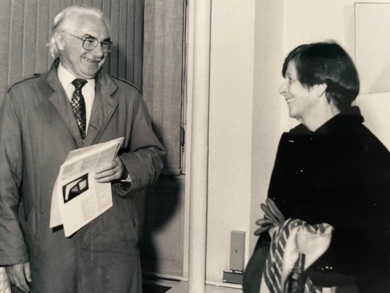
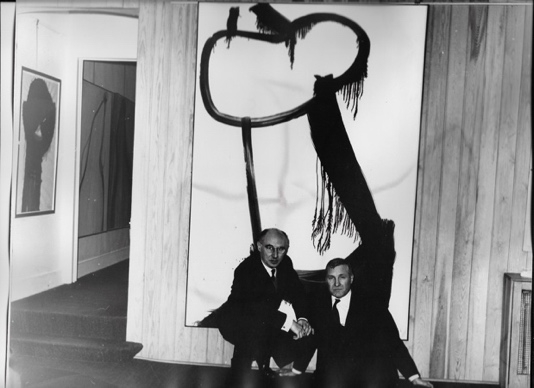
To top it all off, Oscar photographs the artists who interest him and with whom he associates—a valuable archive that speaks volumes about the art world of the time and the practice of a certain kind of patronage that was inextricably linked to friendships.
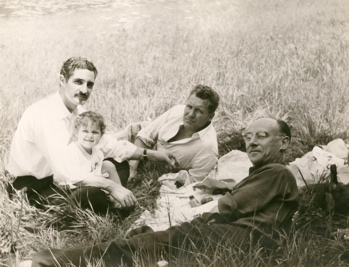
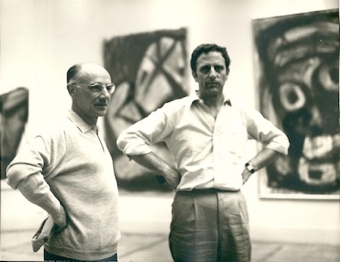
Today’s exhibition is structured around these photographs—in which Mortier is almost always present—drawing inspiration from the works of the artists depicted, who are part of his collection. Among them are François Arnal fig. 3, a French painter of an abstract and lyrical style; Gianni Dova fig. 4, born in Rome, creator of informal and tumultuous art; and those who need no introduction: César fig. 5, Christian Dotremont, Roel d’Haese, Serge Vandercam fig. 6, and Englebert Van Anderlecht. The selected photos show the artists in a joyful, festive, and intimate setting, as well as at exhibition openings. fig. 7
Mortier’s painting may well be the work of a solitary spirit, not given to socializing, but it is rooted in a milieu that, beginning in the postwar years, would serve as a springboard for him. Oscar would always remain his friend and patron—the one with whom he would discuss, exchange ideas, and, when necessary, argue… and who would acquire many of his works not only because he appreciated them but also to help him make ends meet.
Through Oscar or via him, the painter met a host of Belgian and French artists, critics, and collectors. Cécile Houtart fig. 8, Oscar’s wife—an art historian and fashion designer—supported the collector and guided him in his choices. She got along particularly well with Antoine’s wife, Emilienne Lempereur, a seamstress at Natan “who has a golden touch.” The painter, for his part, worked there as a furrier. A genuine bond united the two women, each of whom was grappling with the complex personality of her husband.
The Schellekens lived the high life, hosting parties and shuttling back and forth between Paris and Brussels and other vibrant cities like Milan and Antwerp. Above all, they were close to Viscountess Marie-Laure de Noailles, the rebellious and unconventional muse of the avant-garde, who was at the forefront of the French capital’s art scene and whose famous residence in Hyères, designed by Mallet-Stevens, was dedicated to “modernity.” Oscar and Antoine fig. 9 were therefore well aware of the ideas that were pulling art in all directions during the 1950s. The extensive, eclectic, and abundant collection that the art lover built up in the Brussels mansion—where Mortier occupies a prominent place—is a direct testament to the Schellekens’ open-mindedness as they sought out the “big names,” starting with those in Belgium. Daniel, the son of Oscar and Cécile, now looks after this collection alongside his daughter Laura. Known as Daniel Schell, he is passionate about math, music, and poetry; he is a composer and still teaches. As for Laura, a dendrologist and photography enthusiast, she serves, among other roles, as a board member of the Antoine Mortier non-profit organization alongside Françoise, the painter’s daughter, and Gil Knops, his grandson and co-founder of the Antoine Mortier Fund at the King Baudouin Foundation. Their friendship with one another, as well as their interest in art, has been passed down through the generations.
Although he encountered many artists and trends, Mortier remained true to himself amid the turmoil, following his own path—a quality appreciated by other collectors and experts such as Paul Fierens, Robert Giron, Gustave Van Geluwe, Karel Geirlandt, Bertie Urvater fig. 10, and, a little later, Thomas Neirynck.
— Danièle Gillemon, Member of the Fine Arts Class of the Royal Academy of Belgium